
How it works
What working with us actually looks like.
Embedded teams. Monthly retainers. Code you own. The rest is texture.
DDaaS is unusual enough that “we’ll figure it out as we go” is a fair reaction. So here’s what to actually expect — from the first conversation through the third year of partnership.
The Thrive Advantage
What gets embedded. What stays yours. What we don’t cover.
Most software work is one of two things. Either you license a SaaS tool that almost-fits, or you contract an agency for a specific project that ends with a handoff. Both leave gaps — software that doesn’t quite belong to you, or a partner who isn’t around when the next thing needs building.
Development Department as a Service is the third option. We embed a team into your business each month, the way an internal team would, that operates inside your tools, on your priorities, in your standups. The retainer scales up or down each quarter as the work changes.
What stays yours
All of it — forever
- All code, IP, and architecture, fully transferable
- Documentation, decision logs, and runbooks
- Infrastructure deployed in your accounts, not ours
- A clean handoff path if you ever go in-house
What we don’t cover
The transactional stuff
- Shrink-wrapped marketing sites with no follow-on work
- Pre-built SaaS products you license from us
- Fixed-bid contracts with rigid statements of work
- Single-deliverable hand-offs with no relationship behind them
The engagement arc
From first call to year three.
Most engagements follow this shape, with timing that flexes based on what you’re trying to do. The first three steps are low-commitment and let both sides decide whether to keep going.
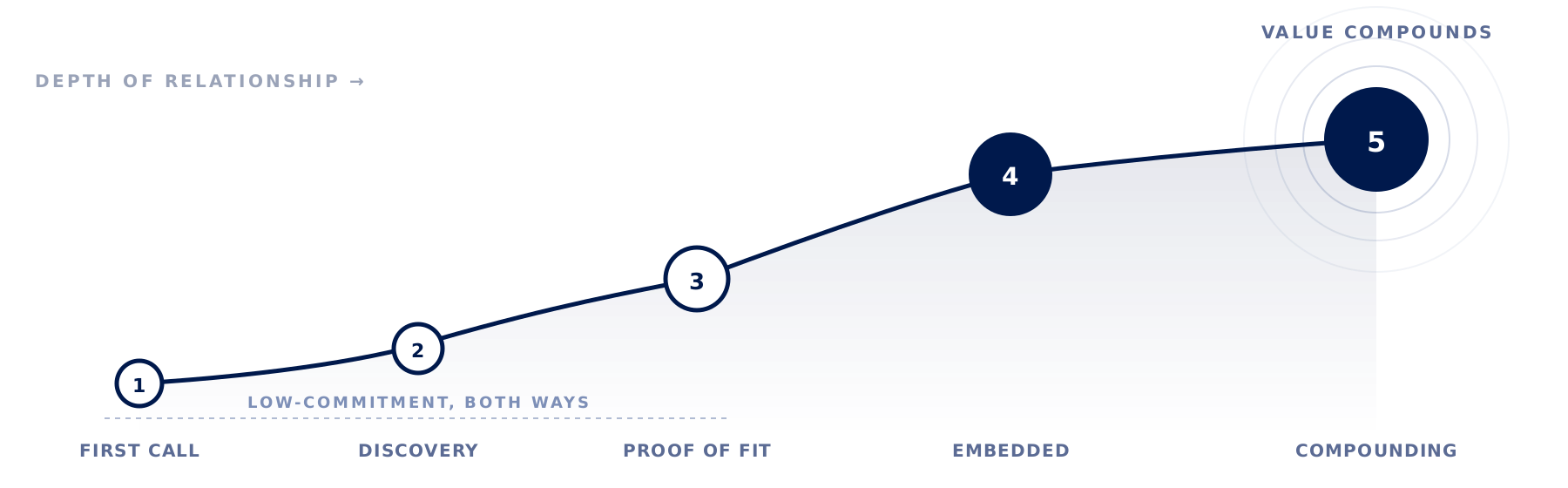
01
First conversation
A 30-minute call about where you are, what you’re trying to build, and whether we can help. We listen. You ask whatever’s on your mind.
No deck. No pitch. An honest read on whether DDaaS is the right shape for the gap — and a referral elsewhere if it isn’t.
02
Discovery & scoping
If the first call lands, we spend a couple of weeks digging into the specific problem: who’s involved, where the constraints are, what success looks like in 90 days, and what the right first piece of work would be.
Conversations with the people doing the work, not just leadership. A written scope at the end you can share, defend, and budget against.
03
First scoped engagement — “proof of fit”
A 2–4 week engagement with a clear deliverable and a fixed price. Low commitment, both ways. You see how we work; we see how we fit your business.
A small but meaningful piece of work shipped. A clear “go forward” or “stop here” decision at the end — with no awkwardness either way.
04
Embedded engagement
The full team — fractional CTO, project manager, designers, developers, AI engineers as needed — operates as part of yours each month. Sprints run weekly. The roadmap is reviewed quarterly.
Same faces every standup. Your priorities drive the queue. Code shipping continuously, fully owned by you, deployed into your infrastructure.
05
How the team scales with you
Each quarter, we resize. New phases, new product lines, new roles dialed in or out as the business changes. The same core team stays; the shape of it flexes.
One contract, no re-procurement. Capacity that matches what the business actually needs — not what the original statement of work assumed twelve months ago.
How billing works
A monthly retainer, sized to the team you actually need.
You’re paying one rate for the whole team — not five rates that add up.
The retainer is set by the size of the team — number of roles, hours per role — and is reviewed every quarter. One hourly rate covers every skill set on the team: strategy, project management, design, engineering, and AI/cloud. No per-specialist upcharges, no surprise line items, no per-user fees. If priorities slow down, the retainer slows down. If they pick up, we scale the team.
Some innovation-focused builds may qualify for Canadian tax incentives like SR&ED or funding programs like NRC IRAP. Where eligible, these can meaningfully offset the cost when the work is structured for them. We’ll scope the engagement to be grant-friendly from the first conversation if that’s a fit.
| SaaS subscription | Fixed-price project | DDaaS retainer | |
|---|---|---|---|
| Cost shape | Recurring — climbs with users and feature tiers | One-time, plus change orders for anything new | Monthly retainer that scales with team size |
| Rate structure | Per-user, per-tier seats | Single project price, no hourly visibility | One hourly rate covers every skill set |
| Code & IP | Theirs — you rent access | Sometimes yours, with caveats and licensing | Always yours, fully transferable |
| Flexibility | Their roadmap, on their timeline | Their statement of work, with friction to change | Your priorities, reviewed weekly |
| Commitment | Per-user, often multi-year | Single-project commitment, then re-procurement | Monthly, no long-term lock |
| After launch | Keep paying forever | They disengage; you find someone else | Same team, same context, next phase |
What you own
Whether you stay a year or a decade, the answer is the same.
Everything we build belongs to you. There’s no proprietary platform you can only run through us, no vendor lock-in clause buried in the contract, nothing that breaks if we walk away tomorrow.
All code, IP & infrastructure
Source, builds, environments, secrets — deployed in your accounts, owned by your business.
All documentation
Architecture diagrams, decision logs, runbooks, onboarding notes. Your future team doesn’t start cold.
All architecture decisions
Why you ended up where you ended up — with the trade-offs explained, so the next call doesn’t repeat the wrong assumption.
A clean handoff path
If you ever bring this in-house, we run a structured handoff — or stay on for fractional support while your team ramps.
What stays embedded over time
The compounding part.
The most underrated piece of DDaaS is the part that doesn’t show up on a deliverables list.
The same team stays across projects. There’s no rotation, no re-onboarding, no quarterly re-explaining of how the business works. The fractional CTO who sat in your first roadmap session is the one in the room when you ship year-three’s biggest feature.
Decisions get faster. Reviews get shorter. New phases land without re-orientation. Six months in, we’re catching things in design that would have shipped as bugs in month one. Year two, we’re proposing changes to the business model based on what we see in the data.
This is the work that compounds. It’s why we’re built for partnerships, not contracts — the most valuable months are the ones nobody scoped at the start.
By year three, the value is not just delivery speed. It is context. The same team knows the business, the people, the tradeoffs, and the history behind the roadmap.
Honesty up front
When we’re not the right fit.
Saves us both a quarter. If any of these describes what you actually need, we’ll happily point you at someone better suited.
Not us
One-off marketing site, no follow-on work
You’ll be better served by a regular agency that does fixed-scope creative work. We’re built for partnerships that compound, not single-deliverable projects.
Not us
You want to license a SaaS product
We don’t sell licenses to a platform we own. Everything we build belongs to you, deployed in your infrastructure. If a SaaS fit is what you need, that’s a different procurement.
Not us
Fixed-scope, fixed-price, no flexibility
DDaaS is built around adjusting to changing priorities. If the procurement demands a locked scope, a locked price, and change-order machinery, that’s a different engagement model than ours.
Not us
You need a single-week turnaround
Our engagement model isn’t designed for week-long sprints — the discovery alone usually takes that long. If pure speed-to-pixel is the only requirement, an existing relationship will get you there faster.
Where to start
Tell us where you are. We’ll tell you what we’d recommend.
A 30-minute call. If we think DDaaS is the right shape for what you’re trying to do, we’ll say so. If something else fits better, we’ll say that too — and point you to it.